JinHanAI

After reading Hardy Tan's China LLM Discussion Notes, I found myself thinking about an awkward question: if a model company ships a stronger model every time and keeps growing revenue, why might its shareholders still fail to make money?
The notes discuss defenses against distillation, compute supply, financing, and falling model prices together. Some of the conclusions are pessimistic, and I do not accept all of them. But following those constraints through reveals an uncomfortable possibility: a company can keep improving while needing ever more money just to stay in the race.
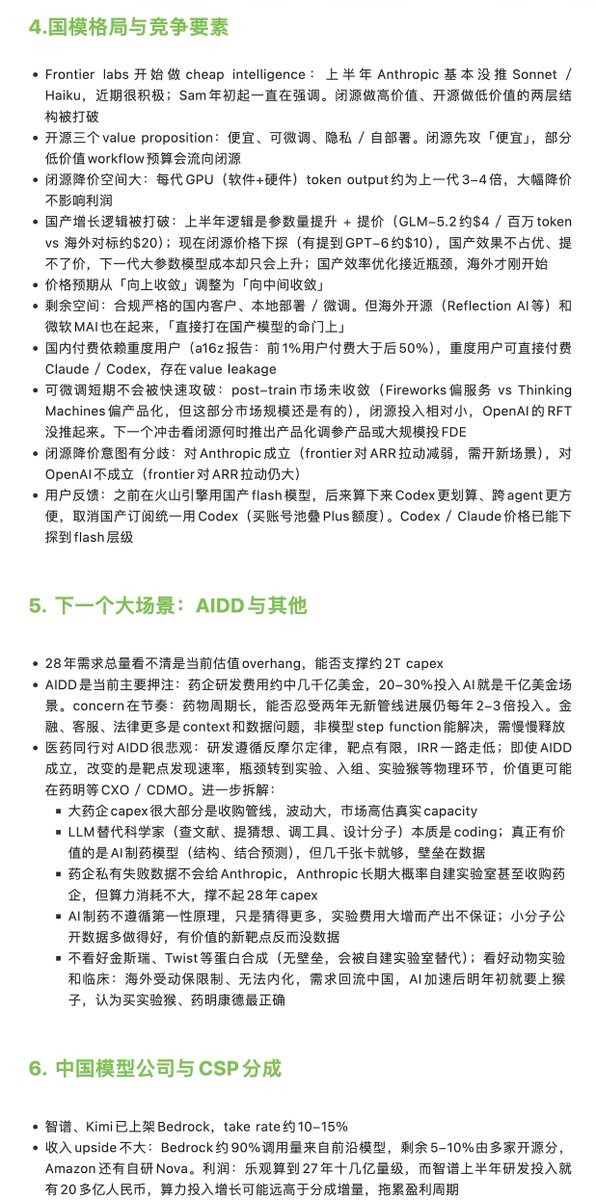
Catching up has to work at the price customers will pay
Distillation, roughly speaking, uses the outputs of a frontier model to help train another model. The notes argue that this route is getting more expensive and that high-quality training signals are harder to obtain. For a challenger, the question is not simply how late the next model will arrive. It is how much additional data, training, and experimentation it will take to reach the same capability.
Look only at that side of the equation and it is tempting to assume that better models will eventually justify higher prices and recover the investment. But no supplier sets prices alone. The notes also argue that frontier closed-model providers are making intelligence cheaper and entering use cases previously served by lower-cost models. Those two claims belong in the same calculation: catching up costs more, while the price customers will accept may not rise at all.
Consider a hypothetical model company. This is an illustration of the mechanism, not a report on a particular business.
It spends more to improve its model and wins new customers. Then a leader cuts prices, and existing customers ask to renegotiate. The company follows the price cut to preserve usage. Revenue may still grow, but it keeps less from each sale, and the next training run is already scheduled. Its model ranking gets closer to the leader while its need for outside financing increases.

In that situation, customers may capture most of the early gains from cheaper intelligence. They get the same work done for less, and usage grows across the industry. Those are worthwhile improvements. How much the supplier retains, though, depends on competition and switching costs. Demand growth alone does not answer that question.
I would not dismiss the opportunities for Chinese models on that basis. Local deployment, industry data, fine-tuning, compliance requirements, and implementation needs can all change a customer's decision. A model need not lead every general benchmark to attract paying customers. But that opportunity has to show up in contracts: why does the customer stay, can customization costs be recovered, and can the delivery work be reused? If every new customer requires another engineering project from scratch, revenue growth may not produce the expected economies of scale.
There are several more calculations after revenue
Revenue at a model company is exciting because it seems to demonstrate both capability and demand. Yet revenue only tells us how much service was sold. Subtract the corresponding cost of revenue to reach gross profit; research, sales, administration, and other expenses still have to come out. Free cash flow asks how much cash operations bring in after capital spending on equipment and other assets. A signed contract is not cash collected, and better gross margins do not guarantee cash left over after expanding compute capacity.
When a model improves, I want to know how much of the additional R&D and investment the incremental gross profit can cover. Spending needed merely to retain existing customers is economically different from spending that opens a new market. If skipping the upgrade means losing the existing business, much of the expenditure maintains a competitive position. Treating all of it as an investment in future growth can overstate the return.
Financing is useful, of course. It keeps research going and buys time to test a technical direction. But when new money arrives, the company's cash balance increases while existing shareholders' ownership may fall. A more valuable company does not necessarily mean the same increase in value per existing share. The return on the new investment must be weighed against dilution and the price paid to obtain that capital.

I do not require an R&D business to have positive free cash flow today. Losses can have sound reasons. What I need is an explanation of how the economics of each unit of business improve as the customer base and technology mature. If every step up in revenue requires a larger injection of capital, and competition then removes the additional profit, an impressive financing history still does not explain what existing shareholders will ultimately keep.
That question naturally leads to compute infrastructure. The notes argue that compute is scarce in China and that suppliers may have more pricing power. That is worth studying. Moving from model companies to compute assets does not remove the need to examine cash flow, though. Equipment must be paid for, financing costs money, and depreciation reflects the consumption of the asset. Its useful rental life and the match between available capacity and peak demand affect how quickly the investment is recovered.
The contracts deserve particular attention. Does a long-term partnership guarantee minimum purchases or merely express an intention? Can the customer renegotiate prices or leave early? What happens to older hardware's rental rates and uses when a new generation arrives before its cost has been recovered? Add customer concentration, ability to pay, and actual utilization, and a clearer picture emerges of how durable today's scarcity revenue might be. Even a good business can deliver an ordinary investment return if the purchase price already assumes an optimistic outcome.
Who receives the money from new use cases?
AI-driven drug discovery, or AIDD, is another topic in the notes that deserves closer examination. New model applications and pharmaceutical R&D budgets are easily joined into a huge demand story. But money a drug company is willing to spend on research does not pass directly, dollar for dollar, into a model company's revenue.
The pharmaceutical participants in the discussion worry that even if AI produces candidate ideas faster, physical work such as experiments and clinical enrollment can remain a bottleneck. I find that a useful caution. More promising ideas on a computer may require more experiments. If validation capacity does not grow with them, queues lengthen and costs can rise first. Whether the process yields an effective medicine still depends on the results.

That makes the recipient of the additional budget important. What irreplaceable capability does the model company provide? Who controls the data, who organizes the experimental resources, and how do the contracts divide the rewards from a successful discovery? Valuable capabilities can sit at several points in the process. If the model is just one replaceable service, progress in drug development may not produce a matching profit for the model supplier.
Equally, identifying experiments and clinical work as bottlenecks does not automatically make the relevant outsourcing companies attractive investments. Demand has to become orders, delivery, and collected payments before it becomes usable cash. Expansion costs, competition, and the valuation paid still matter. Even if validation providers receive more of the budget, shareholder returns depend on the cost of meeting that demand. The size of pharmaceutical R&D as a whole cannot guarantee a model company's future spending on compute.
The notes make me want to spend more time on the accounts after a model launch: the prices customers accept at renewal, the spending needed to preserve that revenue, and the cash the contracts eventually produce. I am keeping an open mind about how Chinese model companies will diverge. Businesses that retain customers through deployment, data, and industry expertise deserve individual study. The expectation that models will keep improving is not enough, on its own, for me to accept a valuation.
Screenshots of the source notes: